Thursday, December 17, 2009

Wednesday, November 18, 2009
Learn and Serve on November 18, 2009

Today in learn and serve I was able to work with a Chinese American student whom I have been able to work with each week. This week we were working on her pronouncing words and by sounding out the word figuring out which letter it began with.
It was quite interesting to see that the mistakes she was making with her letter sounds are the same mistakes all kids make while learning them. She was making mistakes when it came to the G and J, also C and K. You could see the look at her face was so confident. She knew that she knew the letters and words and was excited to show me how much she had progressed.
After we played a game and she did amazing she just looked over at me, gave me a thumbs up, and just smiled. It was so nice to see her happy and proud of herself. Before, at the beginning of my placement, she was scared to talk in front of me because she seemed embarassed. It was hard to ever see her happy, or proud of herself. It felt so good to see that she was proud of herself!
Thursday, November 5, 2009
Blog November 5th

Today in class we worked with students from opportunities unlimited. In a small group we were able to take the student around campus and work on our video/ picture project. Myself and Kristin worked with Lisa. She was so much fun and energetic. When we got back to the classroom we worked together in different stations. The different stations were story telling, play doh, building a fort, and intelligence. We were not able to do all the stations but we did the play doh and the fort. Lisa really enjoyed both. When we played with the play doh she loved talking to us about herself and learning about us. She also seemed to enjoy building the fort because she liked our team work and loved working with everyone.
My experience with Lisa was amazing. I was extremely nervous about meeting my student and was not sure what to expect. I noticed that although Lisa had a disability she was no different than anyone else. She acted and talked almost as if she had no disability. After meeting Lisa and spending time with her my nerves lifted and I became so comfortable. I felt almost as if I was just spending time with a friend!
Chapter 11 talks about students who have trouble seeing. On page 367 in our text there is a statistic that I found interesting. "Measures of social maturity and cognitive development showed delay." I was not able to spend time today with a student who vision is impaired but I could see how it would be difficult for a student who has these obstacles. The activity where we were able to go all over campus and make a film or take pictures in order to make a slide show would be very difficult for that student. Because they would not be able to take the picture or film part of their film it would frustrate them.
Wednesday, November 4, 2009
Learn and Serve on November 4, 2009

Today in learn and serve I was able to work with a kindergarten student who is an ESL student but has progressed so much in the past few months. I was helping her write a short paragraph about her weekend. Before writing out what she wanted to say I had her say it to me, while telling me what she did she spoke proper english. Unfortunately when she went to write down what she said it was completely different. When she was writing she did not use the past tense and was very confused when myself and the teacher explained it to her.
Another student I worked with is one I work with every week. I have blogged about her before, she is Asian American and was having lots of trouble with her english. I was quite surprised and happy to see the progress she has made in just a week. She is now speaking in full sentences, and is having conversations with me and the teacher. We were able to get her to talk to us about her halloween costume. She loved talking about it, you could tell she loved her costume and had so much fun by her expressions.
Thursday, October 29, 2009
October 29, 2009

I noticed that students were having a lot more fun learning by doing the films. By going all over campus with classmates and filming short films gets us out of the classroom and gets us interested in what we were learning about.
I wondered how and where the idea came about to do this activity. I never would have thought to do an activity like this because I was not sure at first why we were doing it.
Next class I'm looking forward to learning more ways to teach students without sitting and reading a book.
Have you ever spent time with an adult with a cognitive or developmental disability? I have never spent time with an adult with a disability. I am actually quite nervous to spend time with the students from Opportunities Unlimited because I am not sure how comfortable I will be around them and I would not want them to feel uncomfortable around me.
Thursday, October 22, 2009
Quiz 7

What kind of activity is this?
This activity was a chalkboard activity. With this activity we drew different pictures and labeled them according to the different disorders that we have learned about this semester.
How does it challenge you?
I was challenged by this activity because it was hard to pick just a few pieces of information that seemed the most important in the reading and abut that disorder.
What background knowledge are you using to complete this activity?
The background knowledge that I am using to complete this activity is what I have learned so far this semester and also what I have seen while working in a classroom at learn and serve.
How much do you love this Blackboard compared to the other Blackboard?
I like this blackboard MUCH more than the other blackboard!
week 8 post
Before watching the video in class today I thought the top 3 things needed while working with parents are being positive about the student, being confident while talking about the student and understanding the child's needs. Another important factor would be having some of their work present during the conference.

To be an effective communicator during a parent conferences you have to be able to tell the parent the good and the bad. You also have to be able to listen to the parent about what the student is telling them. It is very important for you to listen to what the parents think about the class. You also have to be able to defend what it is your doing in the classroom and letting the parent know what the child does in the class.
After watching the film, Home-School Communication: The Parent-Teacher Conference, I realized that there were many more things I needed to be thinking about for parent conferences. The teacher in the film had a good amount of the students work with him already to show the parent. He showed both the positive the negative about the child's work so the parent knew what she had to work more on. There were times when the parent had talked about how the student was feeling when she came home. Not everything she mentioned was positive but the teacher not only addr
essed those problems but he also talked about positive things that do happen in the classroom.
Wadsworth Cengage Learning: Home-School Communication: The Parent-Teacher Conference.
10/28/09 at Sidway
Today in class we worked with the Asian American student again and helping her learn what the word under means. We played a few games and she seemed to have understood what it meant. She had been learning the meaning of under for a few days before I went and from my understanding she was not doing a good job with the worksheets. It is somet
imes difficult to tell whether or not she understands. I feel like she is making good progress but it seemed to me that doing worksheets are still too difficult for her to do. Most of time she can not understand anything on the worksheet and we have to show her a few examples before she has any clue as to what to do with the worksheet.
After leaving learn and serve I felt so good because for the first time I saw my student show us that she understands something and comprehends what we were telling her to do! We played a game where we told her to take a picture and put it under an object in the classroom. After she placed all the pictures under the objects we ask her to go back around, find the pictures and tell us what the picture is of and where she found it. For example, if she found the picture of a pumpkin under the red chair she has to say, "the pumpkin is under the red chair."
Wednesday, October 21, 2009
Sidway on 10/21/09

Todays learn and serve was a lot of fun! I not only got to work with my normal students but was able to work in a classroom with a whole class. Normally myself and the ESL teacher will pull aside certain students to help them but because there was an evacuation drill we decided yo keep them in their classrooms and helping them there.
The first classroom I was in today was a first grade class. In this class there are three students who we normally work with. I sat with one of the female students and helped her with her reading. She seemed to have some trouble with the past tense. So after leaving that classroom I asked my teacher different ways to help the student and she gave me the website, that I have linked for you, to read and see if that helps.
Another classroom I was in was a kindergarten class. In this class is a student that I have worked with closely. In their class they are learning to count in the "teens". I was quite surprised and excited to see how well she was doing. She was able to count along with her fellow students and was able to count alone. The last time I saw her she wouldn't even speak to me but today we had a full conversation.
Wednesday, October 14, 2009
Learn and Serve at Sidway class #2

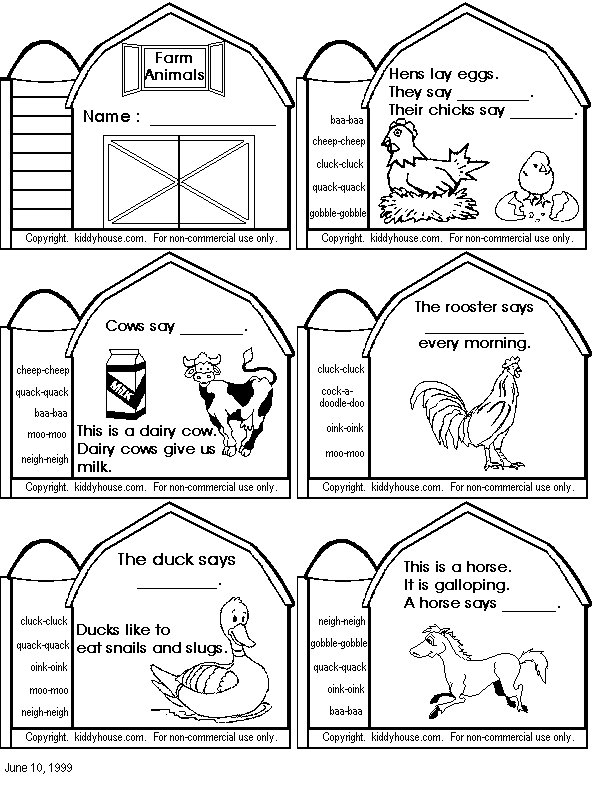
Today in learn and serve I worked with a group of boys who are in kindergarten. We once again helped them learn the different farm animals, the noises they make, and the color/ colors that they are. To help them learn the animals we found worksheets that show which animal is which and we had them color the pictures to match what their true color is.
There were a few students who only knew a few colors and there were others who knew them all! Those who knew them all tried to help the others and wanted to make sure that everyone knew the colors. At one time both myself and the teacher just sat there and watched them teach each other. After they were done learning the colors and coloring in the worksheet we decided to find a book about farm animals and read the book to them.
By the end of the half hour we spent with the students they could not stop talking about the different animals and their favorite animals. They will be visiting the farm next week and they are all excited now because they have a favorite animal and now know what they all look like.
Thursday, October 8, 2009
Learn and serve at Sidway
Today in my learn and serve classroom, at Sidway Elementary, I helped my teacher to explain to an ESL student which animals are on a farm and what color the animals are. Unfortunately this student was not able to understand what we were saying. In order to get any reaction from her we found pictures to show her, hoping if she sees what the animal looks like she will start remembering.
It was very difficult for me to sit there and watch her not understand us. I had learned that the students mother does not help out at home and can not speak english. The mother is a young mother and dropped out of high school because learning english was too hard for her. Unfortunately because the mother does not care about her education her daughter is acting the same way.
We have not only had a problem with her understanding english but her behavior was not good. The teachers think that she acts this way because she gets aggravated that she doesn't understand. In the classroom they have to show her photos of what she should be doing hoping that she understands.
Although this is very difficult, I am looking very forward to going every week and helping this student progress.
It was very difficult for me to sit there and watch her not understand us. I had learned that the students mother does not help out at home and can not speak english. The mother is a young mother and dropped out of high school because learning english was too hard for her. Unfortunately because the mother does not care about her education her daughter is acting the same way.
We have not only had a problem with her understanding english but her behavior was not good. The teachers think that she acts this way because she gets aggravated that she doesn't understand. In the classroom they have to show her photos of what she should be doing hoping that she understands.
Although this is very difficult, I am looking very forward to going every week and helping this student progress.
Sunday, September 27, 2009
Wednesday, September 16, 2009
Chapter 9
Define and discuss the concept of twice exceptional.Students who are identified as gifted and talented in more than one area of exceptionality such as academics, general intellectual ability, creativity, leadership, visual, or performing arts) are considered to be twice exceptional.
Some of the strengths a twice exceptional student would have are great vocabulary, creative, curious, imaginative, wide range of interests, sophisticated sense of humor, etc. Some of the weaknesses would be easily frustrated,opinionated, stubborn, argumentative, etc.
What are some characteristics of children with gifts and talents? Some of the characteristics of children with gifts and talents are memory, abstract thinking, simultaneous thinking, creativity, high performance, high content mastery, high problem solving ability, persistent, goal oriented, high level of language, great listening and speaking vocabulary. This is the photo that I have chose to explainwhat differentiated instruction is. First off,differentiated instruction is the change in teachersstrategies and curriculum made necessary by the characteristics of the child. This picture explains that because it is showing all the different ways a lesson could be taught in order for everstudent to understand. There are many different ways a teacher can explain a lesson, so there isno reason a student should not be reached. Every teacher should plan out there lessons in morethan one way just in case there is a student who needs it taught a different way.
Chapter 2
Identify and briefly explain the six key principles of PL 94-142, the Education for All Handicapped Children Act. There have been six key principles of PL 94-142 that have shaped special and
general education during the past three decades. The six principles are:
- Zero reject- all the children who have disabilities must be given a free and well
educated in the public education.2. Nondiscriminatory evaluation- all students must receive a full individualexamination before being placed in a special education classroom.3. Individualized education program- this must be written for every student with adisability who is receiving special education. It must include the children's currentperformance, goals for the year, and procedures by which outcomes are evaluated.4. Least restrictive environment- children who disabilities must be educated withthose who are not handicapped as much as possible.5. Due process- these are legal procedures to ensure the fairness of educationaldecisions and the accountability of both professionals and parents in making thosedecisions.6. Parental participation- parents are to be included in the development of the IEP,and have the right to access their child's educational records.How are special educators using technology in the instruction of exceptional students?
Special education has often led the way in the acceptance and use of technology in theacceptance and use of technology in education (Educating Exceptional Children, page 63). Most of the time special educators are willing to try new kinds of ways to help their students such as,computers, hearing aids, and print magnifiers. There are two different uses of technology: assistiveand instructional uses. The assistive technology consists of tools that enhance the functioning of people with
special disabilities. It can be as sophisticated as a device that translates print into oral language or as simple as a headband and a pointer that allow students with cerebral palsy to pointto text or communication boards. These devices have improved individual children's ability to receive and transmit information effectively and are most often used with children with moderateto severe disabilities that create major barriers to communication. Instructional technology involves the computer and related tools that support and expand
the computer's usefulness. It is developed primarily as a means to deliver content and instructionin an appropriate manner to exceptional children.Chapter 1
When is a child considered to be educationally exceptional?
A child is considered to be educationally exceptional when they differ the average student in their mental
characteristics, sensory abilities, communication abilities, behavior and emotional development and or physical
characteristics. These differences tend to require either a modification of school practices or special educational
services to develop their unique capabilities.
Some of the main groups of exceptional children are intellectual differences, communication differences,
sensory differences, behavioral differences, physical differences and multiple and severe handicapping conditions.
The students who are intellectually different are not only those who learn slower than others but also those who are
considered gifted and learn much quicker than the other students. Some of the communication differences are with
the students who have learning disabilities, autism and speech and language disabilities.
A child with disabilities can be placed as exceptional in thirteen different (legal) categories, and are
outlined in the Individuals with Disabilities Education Act (IDEA, 2004)(Educating Exceptional Children, page 7-8)
How do parents and siblings respond to the presence of a child with disabilities in the family?
Most of the time families act very strongly about their being disabled, whether it positive or negative. There
are two major responses by the parents and siblings, they are: the "symbolic death" and providing daily care for the child
(Educating Exceptional Children, page 16). Many times parents find out about there child having a disability and feel
in shock, denial, guilty, anger, sadness then finally they adjust. There are cases where parents end up having extreme
depression and they found that support groups with parents going or have gone through the same thing helps and how
they dealt with everything. Another difficult thing to deal with is deciding how they are going to care for this child
everyday. With certain disabilities, it may be difficult to feed, dress, or put to bed and make it harder on the family to
do this everyday of their lives. With some families it requires professional attention to their own feelings.
The realization that their child may not go through the normal developmental process or may never become
independent as an adult often weighs heavily on parents (Educating Exceptional Children, page 16).
Subscribe to:
Posts (Atom)